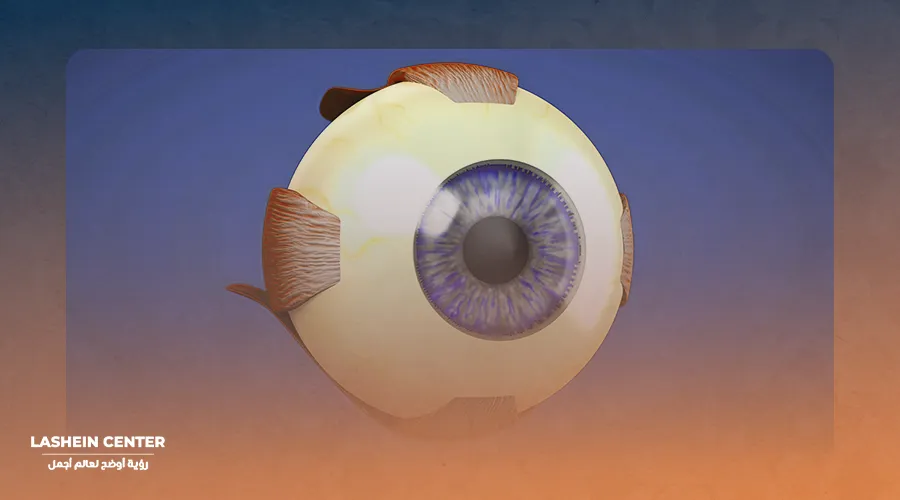
Artificial lens implantation, replacing the natural lens of the eye, is one of the medical solutions ophthalmologists use to correct vision defects. In this article, Dr. Mahmoud Hassan, a retinal, cataract, and lens implantation surgeon at Al-Mashreq Eye Center, holds a Master's degree in Ophthalmology, is a member of the Royal College of Surgeons of Edinburgh, England, and a Fellow of the International Council of Ophthalmology. He will discuss the lens implantation procedure and explain the best types of intraocular lenses.
Get perfect vision! Book an appointment with us now.
Contact us
WhatsApp
Intraocular Lenses
These are artificial plastic lenses covered with a protective layer that shields against ultraviolet rays. They are made of silicone or acrylic and are implanted in the eye to replace the natural lens. This is done to treat diseases that affect the eye's natural lens. There are many types of intraocular lenses, and the best type is chosen based on the doctor's diagnosis and the patient's condition.
Reasons for Intraocular Lens Implantation
Intraocular lens implantation is usually performed to remove the eye's natural lens (lens) damaged by cataracts or to improve and correct vision problems such as nearsightedness and astigmatism by replacing it with an artificial lens. A doctor is consulted to diagnose the condition and its causes, and to suggest the appropriate treatment and the best type of intraocular lens to implant based on the individual's eye condition. These reasons include:
Individuals with severe nearsightedness.
Individuals with severe farsightedness.
Patients with astigmatism.
Age-related farsightedness.
Needing to correct refractive errors but not being a candidate for LASIK surgery.
Cataract removal.
You may be interested in:
How much does intraocular lens implantation cost?
Blurred Vision in Diabetic Patients
Retinal Examination for Diabetic Patients
Types of Intraocular Lenses
Dr. Mohamed Lashin pointed out that there are many different types of intraocular lenses, each with its own advantages and disadvantages. The best type of intraocular lens is chosen based on a doctor's consultation, diagnosis, and the individual's preferences. The most common types include:
Monofocal Lenses
This type of lens is the most commonly used.
Monofocal lenses have the ability to focus on a single object.
The lens power is selected to correct vision for distances such as walking, driving, and watching television. In some cases, it is used to adjust for distances to reduce reliance on reading glasses (for near vision, such as with mobile devices).
Some people cannot adapt to monofocal lenses.
Multifocal Lenses
This type of lens corrects vision for both near and far distances. It contains multiple focal zones that adapt to the brain, enabling it to select the level of focus needed for any task.
It is characterized by reducing the need for eyeglasses.
One of its main drawbacks is that you may notice some slight halos when exposed to light.
Extended depth-of-focus (EDOF) lenses:
These lenses work at a specific focal point.
They contain lenses that expand and correct the field of vision and depth of focus.
They provide excellent distance vision and improve vision at intermediate distances.
However, your doctor may still prescribe eyeglasses for tasks that require close-up vision, such as reading.
4. Phakic IOLs (Secondary Vision Correction Lenses): These are used to correct refractive errors (myopia) without removing the eye's natural lens. They are the ideal choice for young people with high myopia or for whom laser vision correction is not suitable.
5. Astigmatism Correction Lenses (Toric IOLs)
These lenses treat visual distortions resulting from corneal irregularities.
Learn about the cost of lens implantation surgery in Egypt.
Advantages of Intraocular Lens Implantation
Before discussing the best types of intraocular lenses, it's important to first outline the general benefits of lens implantation, which include:
Enhancing vision quality.
Treating patients who are not candidates for LASIK surgery.
Treating acquired farsightedness.
Treating nearsightedness and astigmatism.
Treating cataracts.
Risks of Intraocular Lens Implantation
All procedures have benefits and risks, and lens implantation is no exception. Some risks or complications may arise from implanting secondary lenses (PHAKIC IOLs) into the eye, including:
Increased intraocular pressure.
Development of cataracts.
Best Types of Intraocular Lenses
The best type of intraocular lens is determined by your doctor after diagnosing your condition, whether the treatment is based on:
Cataract surgery.
Refractive Lens Surgery
The doctor will discuss your case and present the options and solutions that will help you obtain the best type of intraocular lens implant. This will be done through a comprehensive eye examination, taking into account your individual case and your acceptance of:
The advantages and disadvantages of the lenses.
The condition of your eye and its needs.
Your available budget for the surgery, as lens prices vary.
For inquiries, book an appointment with Dr. Mohamed Lashin, a retinal, cataract, and lens implant surgeon at Al Mashreq Eye Center. Dr. Lashin holds a Master's degree in Ophthalmology, is a member of the Royal College of Surgeons of Edinburgh, England, and a Fellow of the International Council of Ophthalmology. Consult with the doctor about the types of lenses suitable for your case, given his extensive experience in the field and the center's state-of-the-art technology and equipment that facilitate a more successful procedure.